More from Origen, On angelic administrators and their duties

In this passage, Origen discusses further the relationship between “powers” (ie, angelic beings), and the matters over which they preside.  He distinguishes between the place, and the power.  For example, Hades is both a place for souls, and the angelic being which presides over Hades. In the next passage, Origen will “take refuge in allegory.” 

εἰ οὖν πάντα
δυνάμεων ἐπιστατουσῶν καὶ μεμερισμένων
πάντα τὰ ἐν τῶ κόσμῳ οίκονομεῖται,
τί ἄτοπον ὁμωνύμως
τοῖς  οἰκονομουμένοις , τὰ οἰκονομοῦντα
ὀνομάζεσθαι.  καὶ λέγεσθαι
ὕδατα τὰς δυνάμεις τὰς ἐπὶ  τῶν
ὑδάτων, λέγεσθαι θαλάσσας, τὰς
δυνάμεις τὰς ἐπὶ ταης θαλάσσης, καὶ
οὕτως ἀβύσσους τὰς δυνάμεις τὰς
ἐπὶ τῆς ἀβύσσου, ὅτι γὰρ ὁμωνύμως
τοῖς τόποις καὶ χωρίοις

ὀνομάζονται οἱ διοικοῦντες τοὺς τόπους,
μαρτυρήσει μοι τὸ ἐν τῷ Ἠσαΐα
πνεῦμα λέγον: ὁ ἅδης κάτωθεν ἐπικράνθη
συναντήσας σοι, ὁρᾶς ὅτι
ἅδης ἐστὶ τόπος ψυχῶν, περὶ οὗ
γἐγραπται, ἀποσταφήτωσαν οἱ ἀμαρτωλοὶ
εἰς τὸν ἅδην.  καί ἔστιν ἅδης
ζῶον ὁμώνυμον τῶ τόπῳ ἐκείνῳ,
ὅ ἅδης ὁνομάζεται; ἐὰν
οὖν πρὸς τὴν θάλασσαν λέγηται
ὅτι εἶδεν καὶ ἔφυγεν, ὁμωνύμως τῇ
θαλάσσῃ ἡ δύναμις ἡ διοικοῦσα τὰ
κατὰ τὴν θάλασσαν καὶ ὁδοποιοῦσα
τῷ λαῷ τοῦ θεοῦ, ὡνομάσθη.
ἐὰν οὖν λέγηται ὁ ἰορδάνης ἀπεστράφη
εἰς τὰ ὀπίσω, ὁμωνύμως τῷ ἰορδήνῃ
ποταμῷ, ἡ δύναμις ἡ ἐγκεχειρισμένη
τὴν δύναμιν τοῦ ποταμοῦ, ἰορδάνης ὀνομάζεται.

Thus, if the powers preside over all things, and have divided all things, and all things in the world are thus administered, how is it not fitting that the rulers are named the same as that which they rule? Thus the powers which oversee the waters are called waters, those which oversee seas are called seas, and those which oversee the abysses are called abysses, since those who oversee places are named according to their place and region.

The Spirit testifies for me in Isaiah, saying. "Hades is embittered, having met you." (Is. 14:9) Don’t you see that Hades is a place for souls, about which it is written, "may the sinners be turned to Hades." Yet also there is a being named after this place, who is called Hades? If it is said about the sea that it "saw and fled," then it was about the power who managed the matters of the sea and prepared the way for the people of God, who was likely called the same name.  If it is said that “the Jordan turned its back,” then it is likely that the power who was entrusted with the power over the river is called Jordan, like the river. 

ἐν αὐτῷ,

ΜΑΘΠ

More from Origen on the Psalms: Angelic Warfare, Angelic Administration, and Star-Sickness

It’s been a busy week at work! I’ve been reading more from manuscript, but I haven’t had time to translate much until today. In this passage, Origen discusses further the spiritual powers at work in the universe. Consistent with early Christian thought, he attributes the various Greek gods and divine beings with powerful angelic beings, though he explicitly condemns worshiping them. He also discusses angelic “administration,” and also narrates the fall of a star. Frankly, this portion eludes me entirely. I grasp what he’s saying, but I’m not sure to which star he is referring. As always, corrections on the transcription or translation are welcome.

οὐ πάντη ἀποπεπωκότες τῆς ἀληθείας,
ἀποπεπωκότες δὲ ἐκ
μέρους. οἱ μὲν γὰρ ὡς θεοῖς θύουσιν,
ἁμαρτάνουσιν, εἰ δὲ φαντάζονται
εἶναί τινα δύναμιν περὶ ἐκεῖνα,
οὐχ ἁμαρτάνουσιν, ἔστι γὰρ δύναμις.
ἅς καλοῦσι καὶ νύμφας τινὰς εἶναι
ἐπὶ τῶν πηγῶν, καὶ ἐπὶ παντοῦ
τόπου, θέλουσι δύναμιν ἐπιστατεῖν.
εἴποι δ’ ἄν τις ὅτι εἰ μὲν ἐψυχωμένη
ἦν ἡ θάλασσα, καὶ ἕκαστος
τῶν ποταμῶν; πολὺς ἂν εἴη λόγος
ζητεῖν, ἵνα ᾖ καὶ ταῦτα ἐψυχωμένα.
ἀλλά γε πάντα ἅγια τέτακται
καὶ εἰσὶν ἄγγελοι ἐγκεχειρισμένοι
τὰ θαλάσσια πράγματα , καὶ
ἄλλοι ἄγγελοι οἰκονομεῖν, οἱ μὲν, τὰ
τοῦδε τοῦ ποταμοῦ, οἱ δὲ τὰ ἄλλου
τινὸς ποταμοῦ.

οὕτω δὲ καὶ οἱ
ἄγγελοι οἰκονομεῖν τὰ τοῦ ἀστέρος,
καὶ ποτὲ μὲν θειότεροι ἄγγελοι οἰκονομοῦσι
τὰ τοῦ ἀστέρος. ὅτε ὁ ἀστὴρ οὐ
νοσεῖ. οὐ δὲ λοιμώδης γίνεται, ὅτε δὲ
ἄλλη τίς δύναμις παρείληφεν οἰκονομεῖν
τὸν ἀστέρα, πάντως διὰ τὰς ἁμαρτίας
τῶν ἄνθρώπων. ὅτε χείρονος
δυνάμεως παραλαβούσης τὸν ἀστέρα,
τρέπεται ὁ ἀήρ, καὶ λοιμῶδες κατάστημα
γίνεται, ὥστε τὸν ἀναπνέοντα τὸν ἀστέρα
ἐκεῖνον τὸν ἐφθαρμένον, ἀπὸ δυνάμεως λοιμοποιοῦ,
λοιμώττειν, καὶ νοσεῖν.

They have not departed from the truth entirely, but they have departed in part. Those who sacrifice to these things as gods, they are sinning. But if they imagine that some power is around them, they are not sinning: there is a power. What they call nymphs, some are over the springs, and they want there to be a power in charge of every place. One wishes to ask, “if the Sea was given a soul, were the rivers also given them?” This could be a long subject to pursue, whether these things were given souls. Nevertheless, all things were made holy and there are angels that were entrusted with the matters of the sea. Other angels administer other affairs: some the affairs of this river, and some those of some other river.

In the same way, the angels administer the matters of the Star. There was a time when the more divine angels were in charge of the Star- at this time the Star was not sick, nor had it become pestilent. But then some other power seized the power of the star, as always because of the sins of mankind. After the lesser power had captured the star, the air turned, and the state of pestilence began, such that the star, by breathing that destruction from a pestilent-creating power, now suffers illness and disease.

ἐν αὐτῷ,
ΜΑΘΠ

Origen Transcription and Translation–Part 3

Here, Origen discusses whether rivers, seas, and lands have souls;  he marshals evidence from several places in scripture to suggest that they do, and then wonders if these “powers” taking on various natural forms (rivers, lakes, etc.) are responsible for the pagan practice of making sacrifices to them.  As always, suggestions and corrections are welcome. 

Transcription

ἡ λέξις ἡ λέγουσα, "εἴδοσάν
σε ὕδατα καὶ έφοβήθησαν; ἐταράχθησαν
ἄβυσσοι πλῆθος ἤχους ὑδάτων
." ἐπέρχεται δή μοι
λέγειν, ὅτι πάντα ἐψύχωται, καὶ
οὐδέν ἐστιν ἐν τῷ κόσμῳ κενὸν ψυχῆς.
πάντα δὲ ἐψύχωται σώμασι διαφόροις,
ἐψύχωται ὁ οὐρανός, διὸ ὡς
πρὸς ζῶον αὐτῷ ἡ γραφὴ λέγει, "πρόσεχε #Dt 32:1
οὐρανὲ καὶ λαλήσω" καὶ ἄβυσσe [1]
οὐρανὲ, ἐψύχωται ἡ γῆ, "ῥήματα ἐκ
στόματός μου." καὶ "ἐνωτίζου γῆ." #Is. 1:2
εἶτα ἐψύχωται μὲν οὐρανός, ἐψύχωται
δὲ καὶ ἡ γῆ,  ἆρα θάλασσαι καὶ ποταμοὶ
οὐκ ἐψύχωται; ἢ καὶ ταῦτα ἐψύχωται.
καὶ ἴδωμέν γε ὅτι "ἡ θάλασσα
εἶδεν καὶ ἔφυγεν; ὁ ἰορδάνης
ἐστράφη εἰς τὰ ὀπίσω
" (Ps. 113:3 LXX) καὶ ὅτι ὡς
πρὸς ἐψυχωμένα ὁ λόγος διαλέγεται,
νῦν τῇ λέξει συναγορεύω. τῷ ῥητῷ μόνῳ
παρίσταμαι, θέλων παραστῆσαι
ὅτι πολλάκις λανθάνει ἡμᾶς καὶ ἡ
λέξις κατὰ τὸ ῥητὸν ἔχουσα μυστήρια
θεῖα, καὶ οὐ τοῖς τυχοῦσι γνωστά,
ζητῶ οὖν εἰ δύναμίς τις ἐνδέδυται
τὸ σῶμα τὸ θαλάσσης, καὶ ἄλλη
δύναμις ἐνδέδυται σῶμα ποταμοῦ
τοῦ ϊορδάνου, καὶ ἄλλου ποταμοῦ

φέρ’εἰπεῖν τῶν γεὼν, ἄλλη δύναμις,
καὶ οὕτως ἐπὶ πάντων.
καὶ τάχα τοιαῦτα φαντασθέντες
καὶ οἱ παρ’ἕλλησι περιεργότεροι,
θύουσι τοῖς ποταμοῖς ὡς θεοῖς.
 

[1]  I’m not sure what to do with these three words. They don’t look like they belong to me:  either the scribe missed something or added them by mistake (two close instances of οὐρανέ could cause that).  I’ve left them out of the translation, though I’m happy to hear suggestions.   Here’s the snippet in the ms:

image


Translation

“They trembled,” is not all, but, “the abyss, the depth of the sound of the waters.” Do you see here the difference between the water and the Abyss? [1]  For the Spirit of God was on the water, but Darkness was on the Abyss.  Here, the waters see God, and do not tremble.  But the Abyss does not see God, yet trembles.  For the Abyss, over which was Darkness,  is always in a state of flux and clamor.  Because of this, the demons pleaded with the Lord, so that he would not order them to return to the Abyss.  They said to him, “What is there between us and you, Son of God? You have come to oppress us for a time.” But these instructions for the more divine knowledge, concerning the waters of the Abyss, let us not set them aside, nor what was said just now.  But let us see if it is possible for them to make sense. 

The passage that reads, “The waters saw you and were afraid.  The abyss shook, a deep sound of waters,”  starts to say that all things have souls, and that there is nothing in the world without a soul.  All things are “en-souled” in different bodies.  The Heaven was given a soul, and thus the scripture speaks as if to a living being, “Harken O Heaven, and I will speak” (Dt. 32:1).  The Earth was given a soul, “let the earth hear the words from my mouth,” and “give ear, O Earth!”  If then the Heaven was given a soul, and the Earth was too, would not the seas and rivers have them also?  And these too were given souls.  Let us see indeed that “the sea saw and fled.  The Jordan turned its back,” (Ps. 114:3) and that the passage speaks as if to beings having souls. [2] I agree now with this reading. I will stand only by the literal sense, wanting to show that it often escapes us and that even the reading according to the letter has divine mysteries, and not just those that happen to be known.  Thus I seek to know whether some power has put on the body of a lake, and another power the body of the Jordan river, and of other rivers, and even of the different lands, and likewise for all things.  And perhaps, as things like these displayed themselves, the most eager among the Greeks sacrificed to them as gods. 

[1] Since Origen argues that these are beings with souls, or else spiritual powers, I have opted to capitalize them when he’s not quoting scripture directly.

[2] These following two sentences are a little rough, mainly because I don’t quite know what he means by τῷ ῥητῷ μόνῳ παρίσταμαι.  Something about the literal reading, but I’m not quite sure.

More Transcription and Translation of Origen’s Homilies

I’ve continued transcribing and translating from the recently discovered codex. The material continues to be quite speculative, though I *think* I’m following it. Origen is commenting further on the division of the waters during the creation narrative (those above the firmament, and those below). He takes the passage in an allegorical manner: in his mind we aren’t dealing with “waters perceptible to our eyes,” but δυνάμεις, (spiritual powers). If you spot any errors, or have any suggestions, do let me know.

Transcription

“εἴδοσάν σε ὑδατα καὶ ἐφοβήθησαν.”
ἐγὼ καὶ ἐν
ἀρχῇ τῆς κοσμοποιίας, ὁρῶν πνεῦμα
θεοῦ ὡς φησὶν ὁ προφήτης τῇ διατάξει
τῶν ὁλῶν επιφερόμενoν ἐπάνω
τοῦ ὕδατος, καὶ σκότος οὐχὶ ἐπάνω
τοῦ ὕδατος, ἐκεῖ γαρ τὸ πνεῦμα
τοῦ θεοῦ ἦν, ἀλλ’ἐπάνω τῆς ἀβύσσου,
ὅπου τὸ σκότος, καὶ ὕδατος ὅπου
τὸ πνεῦμα τοῦ θεοῦ, καὶ μετὰ πολλῆς
εὐχῆς παρακαλῶν [1] τὸν θεὸν κινοῦναι
περὶ τῶν κατὰ τοὺς τόπους. ἐπεὶ καὶ
δι’ὕδατα γίνεται τὸ στερέωμα, ἵνα
τὰ μέν τινα μείνῃ ἀνωτέρω, τὰ δέ μείνῃ
κατωτέρω. μήτε ὁ Ισραήλ ἐστιν. οὐ περὶ
αἰσθεντῶν ὑδάτων, ἀλλὰ περὶ δυνάμενων
θειοτέρων κάτω μενουσῶν τοῦ
στερεώματος. τούτων αἵτινες ἦσαν,
ἡ ἄβυσσος, ἧς ἐπάνω τὸ σκότος ἦν,
καὶ γὰρ παλαίομεν πρὸς τοὺς κοσμοκράτορας
τοῦ σκότους τούτου. τὸ δὲ
ὕδωρ, οὗ έπάνω τὸ πνεῦμα ἦν τοῦ θεοῦ,
δυνάμεις ἦσαν κρείττονες. ἄρτι οὖν τοῦ
κόσμου κτιζομένου, ἦν ἕν ούκ οἶδ’ὅπως
ταῦτα, οὐδέπω διακεκριμένα. ἡδε
κοσμοποιϊα, διέκρινε τὰ κρείττονα,
καὶ οἷς οἰκεῖον ἦν τὸ πνεῦμα τοῦ
θεοῦ, ἀπὸ τῶν χειρόνων, καὶ τὰ χείρονα,
καὶ οἷς συνέζευκται τὸ σκότος,
τὸ λεγόμενον εἶναι ἐπὶ πρόσωπον τῆς
ἀβύσσου, ὅτι δὲ ταῦτα οὐ συντυχικά
ἔστιν ἐν τῇ γενέσει, δηλοῖ καὶ ἡ ἐνταῦθα
λέξις λέγουσα, “εἴδοσάν σε ὕδατα, ὁ θεός,
εἴδοσάν σε ὕδατα καὶ έφοβήθησαν.”

[1] In the translation, I’ve understood this as παρακαλοῦν, that is, a neuter rather than a masculine participle. From what I recall πνεῦμα could take on masculine forms in certain instances, but I don’t recall the details.

Translation

“The waters beheld you, and were afraid.”
In the beginning of the creation narrative, I see
the spirit of God, as the prophet says, by an order [from God]
brooding over all of the waters; and I see the darkness,
not upon the water, for there the Spirit of God was,
but in some places the darkness was upon the abyss, and
in some places the Spirit of God was upon the water, and
he (the Spirit) cried out with a great prayer that God would move
each their respective places. Thus, because of the waters
the firmament was created, so that some water would
remain above, and some would remain below. But is not
Israel [ie, this is a spiritual matter]; it is not about waters
perceptible to our senses, but about divine powers
remaining below the firmament. There were several of these,
and the abyss, over which there was darkness, was one of them:
we wrestle against the cosmic powers of this darkness. But
the waters, over which the Spirit of God was, were mightier
powers. Now just prior to the world’s creation, they were
one, and I don’t know what their nature was, before they
were divided. But the creation narrative distinguishes
the greater things, those to which the Spirit of God was suitable,
from the lesser ones, to which darkness was joined, which is
said to be over the face of the abyss. Because these things
are not found in Genesis, the reading here makes is clear
saying, “The waters saw you, O God. The waters saw you and
were afraid.”

AP

The Genre of the Origen Homilies

Over at Evangelical Textual Criticism, Dirk Jongkind has an interesting post about a variant in 1 Cor. 4:13 which he found in the newly discovered Origen manuscript (Bayerische Staatsbibliothek, Cod. graec. 314).  Near the end, he asks,

However, since these are sermons, do we know how these were published? Did someone take short-hand notes? And were these then later cleaned up and edited? Or did Origen write the sermon first and read it out? This last option is unlikely for a man as brilliant as Origen.

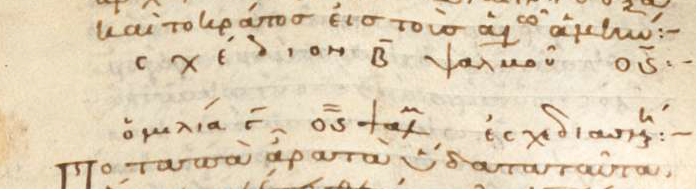
I think I’ve found evidence that suggests that these were, more or less, impromptu or extemporaneous lectures.  In particular, the scribe uses σχέδιον and cognate forms to refer to the homilies.  τὸ σχέδιον, according to LSJ, can mean “extemporaneous, or impromptu speech.”

Here is an example from the section with which I’ve been working on this blog:

image

The first line contains the end of the previous homily, “καὶ τὸ κράτος εἰς τοὺς αἰῶνας ἀμήν.” Then, the second line reads, “σχέδιον β’ ψαλμοῦ οστ’” (The second σχέδιον on the 76th psalm), which closes the previous homily.  On the next line, we see a cognate form: “ὁμιλία γ’    οστ’  ψαλμοῦ        ἐσχεδιασμένη.” (The 3rd homily on the 76th psalm  ἐσχεδιασμένη”

Here we perfect passive participle form of σχεδιάζω, which according to the LSJ  means, “do a thing off-hand, or on the spur-of-the-moment, improvise.” So, we have an improvised speech.

This leads me to believe that we’re dealing with impromptu speeches, which are likely in response to questions.  This particular “homily” could easily have been sparked by, “Of what kind are these waters that see God?”” which is the first sentence of this homily.

This also leads me to believe that “homily” is something of a misnomer.  The Greek word, of course, is ὁμιλία, the word from which we derive “homily.”  However, in English homily always refers to a speech delivered in a liturgical context (ie, a sermon).  The Greek word has a long history, and only came to be applied to sermons in the Christian era.  LSJ lists a number of meanings, but I think “lecture” is likely the most suitable English word (though that does connote a prepared speech, and these appear to be extemporaneous).

Thus, I think the setting for at least some of these “homilies” was the school, rather than the church.  This would be the more appropriate setting for philosophical speculation we see here.  For an article contrasting Origen’s public and private views, see here.  They might also be contrasted in terms of setting: public, more certain theology was for the Church.  Private, more speculative philosophy/theology was for the school.  My guess is that the text we have contains both sorts.  The homilies on Ps. 36-38 that Rufinus translated sound more like moral exhortations than philosophical speculation.  Here, though, we have the latter.


ἐν αὐτῷ,

AP

Update: I was unsure initially, but the ms. reads ἐσχεδιασμένη (sc. ὁμιλία).  I’ve updated the post accordingly.

Greek Paleography Tutorial Posted

I spent the morning writing up a short Greek paleography tutorial.  It’s targeted at people who have at least an intermediate knowledge of Greek, but haven’t done much paleography themselves (ie, they haven’t read from manuscripts).  Because of the clarity of hand, I think the recently discovered Bayerische Staatsbibliothek, Codex graeca 314 (the Origen manuscript) is an excellent introduction to “reading a manuscript for oneself.”  Plus it will allow one to take part in excitement of the new discovery.  It remains to be seen how useful the page will be, but I do hope it’ll be useful for those who haven’t yet worked with Greek manuscripts.  So, for those who would like to read this exciting ms, but haven’t read from a ms in a while, take a look and let me know what you think.  You can find it in the title-bar, or here

Possible Origenic Homily – Transcription/Translation Excerpts

As promised, this post will contain a short transcription and translation of Bayerische Staatsbibliothek, Codex graeca 314, the codex which scholars recently have rediscovered and believe contains a large number of homilies of Origen of Alexandria. Alin Suciu and Roger Pearse both have great summaries of the discovery. Mark Bilby has noted on Suciu’s blog that these may well be the earliest, large scale treatments on the Psalms extant, which means they are a big deal.

I picked a rather arbitrary spot to transcribe and translate. I decided to start with the 3rd homily on Psalm 76 (LXX). This begins on folio 193v (page 393 in my PDF). In this excerpt, Origen is commenting on the nature of the “waters which see God,” which comes from Psalm 77:16 (Hebrew numbering). The NETS translates it thus, “The waters saw you, O God, the waters saw you and writhed; the very depths were convulsed. The waters saw you, O God, the waters saw you and writhed; the very depths were convulsed.”

Our author proceeds to explain the nature of these waters, and their relationship with the three heavens. The comments are speculative and “cosmic” in nature, which comport nicely with Origen’s reputation. That, along with a few stylistic characteristics make me think that Origenic authorship is likely. For example, the use of ἔοικε (it seems) sounds like Origen, but I’ve haven’t read enough Origen to know how widespread that is.

At any rate, here’s transcription and translation. There are likely errors, so if you spot anything amiss, do let me know. I’m running out of time at the moment to do any more, though hopefully I’ll post some more soon. I’m not sure exactly what the passage is doing yet, and I suspect I need to get farther before I figure it out. Still, hopefully someone will find this useful.

Greek Psalms


εἴδοσάν σε ὕδατα, ὁ θεός,
εἴδοσάν σε ὕδατα καὶ ἐφοβήθησαν
καὶ ἐταράχθησαν ἄβυσσοι πλῆθος ἤχους ὑδάτων

Transcription

ὁμιλία γ’ οστ’ ψαλμου ἐσχεδιασμένα

Ποταπὰ ἆρα τὰ ὕδατα ταῦτα,
ἅπερ βλέπει θεόν; τῶν ἀνθρώπων μετὰ
πολλοῦ καμάτου τέλος τοῦτο λαμβανόντων,
κατὰ τὴν λέγουσαν γραφην,
μακάριοι οἱ καθαροὶ τῇ καρδίᾳ,
ὅτι αὐτοὶ τὸν θεὸν ὄψονται. ἔοικε
γὰρ τὰ ὕδατα ταῦτα ἤτοι
παραπλήσια εἶναι τοῖς καθαροῖς
τῇ καρδίᾳ, τοῖς ὀψομένοις τὸν Θεὸν,
ἤ τάχα καὶ κρείττονα εἶναι τῶν
καθαρῶν τῇ καρδία ανθρώπων. έὰν
γὰρ δυνάμεις τινὲς ὦσι μακάριαι
καὶ θεῖαι, τὰ ὕδατα τα βλέποντα τὸν
θεὸν, ἀνάγκη ταῦτα εἶναι ἀνθρώπων κρείττονα.
καὶ ἔοικέ γε τοῦτο ὑποβάλλεσθαι
ἐν τῶ ἑκατοστῶ τεσσαρακαστῶ, καὶ ὀγδόῳ ψαλμῷ,
ἔνθα προστάσσεται ὁ
Ισραῆλ πᾶς ὑμνεῖν τον θεὸν, φησὶ γὰρ αἴνειτε
τὸν θεὸν οἱ οὐρανοὶ τῶν οὐρανῶν, καὶ
τὸ ὕδωρ τὸ ὑπεράνω τῶν οὐρανῶν
αἰνετάτω τὸ ὄνομα Κυρίου. πόσα με
δεῖ καμεῖν ἵνα ἀναβῶ εἰς πρῶτον
οὐρανόν; πηλίκον γενέσθαι, ἵνα
ἀξιωθῶ δευτέρον; Παύλου παραπλήσιον
εἶναι με δεῖ, ἵνα ἀναβῶ ἐπὶ τὸν
τρίτον. κἂν γένωμαι ὡς Παῦλος,
οὕπω ἐπὶ τὸν ἑξῆς οὑρανόν, τὰ δέ
ὕδατα ταῦτα, τὰ αἰνοῦται, κατὰ
τὸν προφήτην, τὸν θεὸν, ὑπεράνω
τῶν οὐρανῶν. ἇρ’ οὖν ταῦτα λέγεται,
τὰ ὕδατα διὰ τοῦ ὑπεράνω εἶναι
πάντων τῶν οὐρανῶν, διὰ παντὸς
βλέπειν τὸ πρόσωπον, οὐ τοῦ πατρὸς
τοῦ ἐν τοῖς οὐρανοῖς, ἀλλὰ τὸν θεόν.
οἱ μὲν γὰρ ἄγγελοι διὰ παντὸς βλέπουσι
τὸ πρόσωπον τοῦ πατρὸς τοῦ ἐν τοῖς
οὐρανοῖς, αὐτὸν δὲ τὸν θεὸν. οὐχὶ διὰ παντὸς
κατανοεῖ ταῦτα τα ὕδατα περὶ
ὣν ὁ λόγος φήσι, εἴδοσαν σε ὕδατα,
ὁ θεός. ἅμα δὲ καὶ ἐξετάξετο ὁ δυνάμενος
συγκρίνειν πνευματικὰ
πνευματικοῖς. ἆρα γὰρ, ὡς έτυχεν ὁ λόγος
ἔιρηκε περὶ τῶν ἀγγέλων
τῶν συνεζευγμένων τοῖς ἀνθρώποις.
οὐχ ὅτι βλέπουσι τὸν θεὸν, ἀλλὰ τὸ
πρόσωπον τοῦ πατρὸς τοῦ ἐν τοῖς οὐρανοῖς.
περὶ δὲ τῶν ὑδάτων τούτων
“εἵδοσαν σε” οὐκ εἴδοσαν τὸ πρόσωπον
σου ὕδατα, ὁ θεός.

Translation

Homily 3 on the 76th Psalm (77th Hebrew/English numbering)
Off-hand Statements

Of what sort are these waters, which see God? Men obtain this goal after much work, according to the scripture which says, “Blessed are the pure in heart, for they shall see God.” It seems then that these waters are indeed similar to the pure in heart, who see God, or perhaps, are greater than those men who are pure in heart. If some powers are blessed and divine, like these waters that see God, it must be that they are greater than men. And it seems that this is put forward in the 148th psalm, wherein (the powers) having been arrayed, all of Israel praises God, for it says,

“Praise God, Oh Heavens of the Heavens! And let the water which is over the heaven praise the name of the Lord!”

How must I labor so that I may ascend into the first heaven? What must happen so that I may be considered worthy of the second? I must be like Paul, if I should go to the third. And if I should become as Paul, I will still not have yet seen the following heaven, these waters which praise God, according to the prophet, beyond the heavens. Therefore this is said, that the waters, through being beyond the heavens, always see, not the face of the father in the heavenlies, but God himself.

For though the angels always see the face of the heavenly Father, the waters see God himself. For are they not always gazing intently, these waters about which the passage says, “The waters have seen you, O God?” Thus let the one who is able to judge spiritual matters among the spiritual people arrange it thus. Perhaps the passage has spoken about angels who are coupled with men, not that they see God, but rather the face of the Father in Heaven. But, concerning these waters, it said, “They have seen you” not, “they have seen your face, O God.”

Updates:

  • Corrected κρείτονα to κρείττονα
  • Corrected ἀγάγκη to ἀνάγκη

Manuscript discovered containing (most likely!) homilies of Origen

Many will have already heard the news from other sources (id est, here or here) that researchers in Europe believe they have uncovered a manuscript containing lots of material from Origen’s Homilies on the Psalms. 

This is really big news.  Caution is still warranted:  the results of the inquiry thus far are preliminary; however, it does appear that there are plenty of reasons to be excited.  For those unaware, Origen was easily one of the most influential and important thinkers of the early Church (he died around 250).  His output was enormous, and included philosophical/theological works, exegesis, and plenty else.  He influenced many of the other important early Christian thinkers (Eusebius of Caesarea, the Cappadocians, Chrysostom, Jerome, etc.), but because of some of his more "speculative" thoughts he was thrown into disrepute because these ideas didn’t mesh with later standards of orthodoxy.  Thus, we have but a fraction of his work at all, and less in the original Greek.  Thus, it will be a treat to see more of what Origen had to say on the Psalms, and also see how other people used/abused/re-worked it in their own work. 

The manuscript itself, according to the library catalog, is a 12th century codex.  Like Roger Pearse, I am greatly excited to see that the German library responsible for the work has placed images of the manuscript online.  What is more, you can download a PDF of the entire manuscript, rather than simply use their web interface!  This truly is "Digital Humanities" at its best: free and open access like this make it possible for scholars (and wanna-be scholars like me) to see the manuscript for ourselves, rather than waiting for a select few to hand down their thoughts.  I hope more libraries follow their lead!

I’ve been looking at the manuscript myself:  it’s a joy to read.  The scribe’s spelling and accent placement are fantastic, which makes reading it much easier than most of the other mss at which I’ve looked.  The Greek itself isn’t too bad either.  Fortunately, exegetical works, by their nature, tend to be easier than other genres. 

I’ll post a little bit of transcription and translation soon.  I more or less flipped around in the manuscript until I found the start of a homily: this bit will be his comments on the end of Psalm 77, where the “waters have seen God, and fear him.” In it, the author discusses the nature of these waters, and their relationship to the three heavens.  I’m not at all an Origen expert, but it is consistent with what I’ve read about him. 

ἐν αὐτῷ,

AP

More Chrysostom on Prayer.

I’ve not posted in quite some time, and I can’t really say that this post represents a return to frequent posts.  However, I came across some Chrysostom that was too good not to share.  As is customary, I give my translation and then the Greek.  Enjoy!

Do you see, then, how powerful are both prayer and petition?  They make men into temples of Christ!  Just as gold, precious stones, and marble make the houses of kings, so prayer creates temples of Christ. “That Christ,” he says, “may dwell in your hearts.”  What greater praise of prayer could ever be, than that it creates temples for God?  The one whom the heavens do not contain, this is the one who enters the living soul through prayers.  “‘The heaven is my throne,'” he says, “‘and the earth my footstool.  What type of house will you build for me?’ says the Lord. ‘Or what place of rest for me?'”  But nevertheless Paul builds him a house through his holy prayers.  He says, “I bend my knees before the Father of our Lord Jesus Christ, so that the Christ may dwell in your hearts through faith.”  Indeed from that, one should know the power of holy prayers, since Paul, the one who ran as though with wings through the entire world, who made his residence in prison, who bore whips and chains, always living in blood and danger, who drove out demons and raised the dead, and who healed sicknesses, he trusted none of these things for the salvation of men, but defended the earth through his prayers, and after the signs and the raising of the dead, he ran again to prayers, just as an athlete returning to the training room right after receiving the crown.


And the Greek:

Ὁρᾷς, ὅσον ἰσχύει προσευχὴ καὶ δέησις; Ναοὺς Χριστοῦ τοὺς ἀνθρώπους ἐργάζεται· καὶ ὥσπερ χρυσὸς, καὶ λίθοι πολυτίμητοι, καὶ μάρμαρα ποιοῦσι τοὺς οἴκους τῶν βασιλέων· οὕτω προσευχὴ ναοὺς τοῦ Χριστοῦ. Κατοικῆσαι, φησὶ, τὸν Χριστὸν ἐν ταῖς καρδίαις ὑμῶν. Τί μεῖζον ἂν γένοιτο προσευχῆς ἐγκώμιον, ἢ ὅτι ναοὺς ἀπεργάζεται Θεοῦ; Ὃν οὐ χωροῦσιν οὐρανοὶ, οὗτος εἰς ψυχὴν εἰσέρχεται ζῶσαν ἐν προσευχαῖς. Ὁ οὐρανός μοι θρόνος, φησὶν, ἡ δὲ γῆ ὑποπόδιον τῶν ποδῶν μου. Ποῖον οἶκον οἰκοδομήσετέ μοι; λέγει Κύριος· ἢ τίς τόπος τῆς καταπαύσεώς μου; Ἀλλ’ ὅμως οἶκον ὁ Παῦλος οἰκοδομεῖ διὰ τῶν ἁγίων εὐχῶν. Κάμπτω, φησὶ, τὰ γόνατά μου πρὸς τὸν Πατέρα τοῦ Κυρίου ἡμῶν Ἰησοῦ Χριστοῦ, ἵνα κατοικήσῃ ὁ Χριστὸς διὰ τῆς πίστεως ἐν ταῖς καρδίαις ὑμῶν. Καὶ μὴν κἀκεῖθεν ἴδοι τις ἂν τὴν δύναμιν τῶν ἁγίων εὐχῶν, ὅτι Παῦλος ὁ διὰ πάσης τῆς οἰκουμένης ὥσπερ ὑπόπτερος τρέχων, καὶ δεσμωτήριον οἰκῶν, καὶ μάστιγας ὑπομένων, καὶ φορῶν ἅλυσιν, καὶ ζῶν ἐν αἵματι καὶ κινδύνοις, καὶ δαίμονας ἐλαύνων, καὶ νεκροὺς ἐγείρων, καὶ παύων ἀῤῥωστήματα, οὐδενὶ τούτων ἐθάῤῥησεν εἰς σωτηρίαν τῶν ἀνθρώπων, ἀλλὰ ταῖς προσευχαῖς ἐτείχισε τὴν γῆν, καὶ μετὰ τὰ σημεῖα καὶ τὴν τῶν νεκρῶν ἀνάστασιν, ἐπὶ τὰς προσευχὰς ἔτρεχεν, ὥσπερ τις ἀθλητὴς ἐπὶ παλαίστραν ἀπὸ στεφάνου.

John Chrysostom, De Precatione (PG 60.783)


John Chrysostom on Prayer (Part 3)

Here’s a third excerpt from one of John Chrysostom’s homilies De Precatione (On Prayer). Parts 1 and 2 can be found here and here. See part 1 for the link to the Greek text. I start translating at Ὅστις γὰρ οὐ προσεύχεται τῷ Θεῷ.


“For the one who does not pray to God, who does not desire to enjoy such divine communion, is dead and soul-less, and has no share of wisdom. For this is a great sign of foolishness, to not understand the weight of this honor, to not passionately desire prayer, to bring death to the soul by not worshiping God. Just as our body, when not having a soul, is dead and decaying, so it is with the soul: when it does not move itself to prayer, it is dead, wretched, and decaying … But when I see someone who has an insatiable desire for serving God, and who immediately considers the lack of prayer a great loss, I consider this one to certainly have all of the virtues of discipline, as if they were the temple of God.”

John Chrysostom. De Precatione.

Edit: Typo corrected.