The Genre of the Origen Homilies

Over at Evangelical Textual Criticism, Dirk Jongkind has an interesting post about a variant in 1 Cor. 4:13 which he found in the newly discovered Origen manuscript (Bayerische Staatsbibliothek, Cod. graec. 314).  Near the end, he asks,

However, since these are sermons, do we know how these were published? Did someone take short-hand notes? And were these then later cleaned up and edited? Or did Origen write the sermon first and read it out? This last option is unlikely for a man as brilliant as Origen.

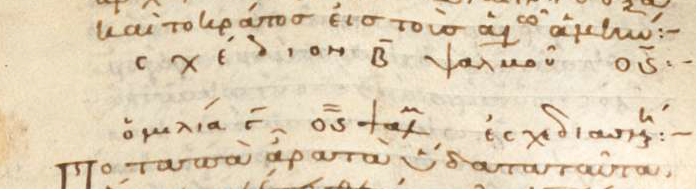
I think I’ve found evidence that suggests that these were, more or less, impromptu or extemporaneous lectures.  In particular, the scribe uses σχέδιον and cognate forms to refer to the homilies.  τὸ σχέδιον, according to LSJ, can mean “extemporaneous, or impromptu speech.”

Here is an example from the section with which I’ve been working on this blog:

image

The first line contains the end of the previous homily, “καὶ τὸ κράτος εἰς τοὺς αἰῶνας ἀμήν.” Then, the second line reads, “σχέδιον β’ ψαλμοῦ οστ’” (The second σχέδιον on the 76th psalm), which closes the previous homily.  On the next line, we see a cognate form: “ὁμιλία γ’    οστ’  ψαλμοῦ        ἐσχεδιασμένη.” (The 3rd homily on the 76th psalm  ἐσχεδιασμένη”

Here we perfect passive participle form of σχεδιάζω, which according to the LSJ  means, “do a thing off-hand, or on the spur-of-the-moment, improvise.” So, we have an improvised speech.

This leads me to believe that we’re dealing with impromptu speeches, which are likely in response to questions.  This particular “homily” could easily have been sparked by, “Of what kind are these waters that see God?”” which is the first sentence of this homily.

This also leads me to believe that “homily” is something of a misnomer.  The Greek word, of course, is ὁμιλία, the word from which we derive “homily.”  However, in English homily always refers to a speech delivered in a liturgical context (ie, a sermon).  The Greek word has a long history, and only came to be applied to sermons in the Christian era.  LSJ lists a number of meanings, but I think “lecture” is likely the most suitable English word (though that does connote a prepared speech, and these appear to be extemporaneous).

Thus, I think the setting for at least some of these “homilies” was the school, rather than the church.  This would be the more appropriate setting for philosophical speculation we see here.  For an article contrasting Origen’s public and private views, see here.  They might also be contrasted in terms of setting: public, more certain theology was for the Church.  Private, more speculative philosophy/theology was for the school.  My guess is that the text we have contains both sorts.  The homilies on Ps. 36-38 that Rufinus translated sound more like moral exhortations than philosophical speculation.  Here, though, we have the latter.


ἐν αὐτῷ,

AP

Update: I was unsure initially, but the ms. reads ἐσχεδιασμένη (sc. ὁμιλία).  I’ve updated the post accordingly.

ΠΙΣΤΙΣ ΧΡΙΣΤΟΥ and John Chrysostom (Part 6)

This post is a part of a series: parts one, two, three, four, and five.

This post should round out my posts on πίστις Χριστοῦ, at least for now. This one should be rather brief. John’s comments on Eph 3:12, “In him, and through faith in him, we may approach God with freedom and confidence,” are very brief. He does have a few interesting things to say about faith when discussing the prayer around 3:17ish. Thus, let us begin.

The first place to start is 3:12. John quotes the verse and then offers a comment or two: “‘In whom’, he says, ‘we have the boldness to approach him with confidence, through faith in him.’ Not as captives, he says, do we approach him, nor as those worthy of pardon, nor as ones who have sinned. This boldness, he says, we have in confidence. That’s to say, we have it with courage. Where does it come from? It comes from faith in him. (Πόθεν; Διὰ τῆς πίστεως αὺτοῦ.).” The comments are sufficiently vague that they could be rendered as “through his faithfulness” if that could be established elsewhere. But since he usually means “through faith in him” where that comes up, it’s proper to read it as we have traditionally: “through faith in him.” Though I do wonder about the article. What’s the difference between Διὰ τῆς πίστεως αὺτοῦ. as we have here and διὰ πίστεως Ἰησοῦ Χριστοῦ in Romans? Anything significant? Anything that we could actually know? I guess I’ll have to defer to the linguists for now. I don’t have a clue!

Next, we’ll look at a few things he has to say about the prayer in 3:14-21. “‘So that he may strengthen you with power through his Spirit in your inner beings, so that Christ may dwell in your hearts though faith.’ See how he prays good things for them, and with such great desire, so that they may not waver. But how does this happen? Through the Holy Spirit, in your inner beings, Christ lives through faith in your hearts. How? In love, being rooted and established, so that you may experience together with all the saints, how wide and long and high and deep is the love of Christ. Later on, after tying 3:14-21 to the prayer in chapter 1, he continues, “This power, he says, strengthens us to bear temptations, so that we may not lead astray. How does Christ dwell in hearts? Hear the words of Christ himself, “The father and I, we will come and make a dwelling place with him.” And he doesn’t just dwell, but he dwells in your faithful hearts, which rooted are rooted in his love, not being lead astray.”. Later he talks about “knowing that Christ lives in us through faith.” The cognitive element is fairly strong here, just like it is in Philippians. The last little bit shows that that Christ’s dwelling in us results in us having “faithful hearts,” (ἐν ταῖς καρδίαις ταῖς πισταῖς) that are “rooted in his love,” and “not led astray.” Thus, this knowledge of Christ does impact us. It enables our own faithfulness. John thus sees our faithfulness as part of that prayer, perhaps even the reason Paul prays it. The faithfulness of God isn’t in sight, but ours is.

Essentially, these passages back up much of what we see in Philippians. Faith is knowing and experience Jesus through the Spirit. John’s comments on 3:12, though ambiguous, support a “faith in Christ” reading since he doesn’t offer any indication to the contrary. We know Christ through faith, and this knowing results in Christ dwelling in us through the Spirit. It creates faithfulness in our own hearts as we are strengthened in him, rooted in his love. Faith and faithfulness are intertwined, though distinct.

ἐν πίστει αὐτοῦ,
Alex

ΠΙΣΤΙΣ ΧΡΙΣΤΟΥ and John Chrysostom (Part 5)

This post is a part of a series: parts one, two, three, and four.

Unfortunately (or fortunately considering the length of the last post), I forgot a fascinating portion that comes right before John’s discussion in Eph 2:8. It provides some prior context for his discussion on faith then. After talking at length about the being raised and seated with Christ, he goes into this passage:

We are in need of the Spirit of revelation, so that we may know the depth of these mysteries. Then, so that you will not disbelieve, see what follows. “So that he may display, in the coming ages, the surpassing riches of his grace, expressed in his kindness toward us in Christ Jesus.” As he said these things concerning Christ, do they matter to us? Some say, “what is it to us, if he rose?” But he shows that these things are indeed for us, if he is joined to us. Else, he would be saying these things about himself, “while we were dead in transgressions, he raised us and seated us with him.” Thus, as I have been saying, don’t disbelieve! He takes up this demonstration to show his goodness from the first things and the head. How does he show this, if these things have not yet happened? [being seated in the heavenlies] They happen in the coming ages. What [is proved]? That his good works were astounding, and that he was the most faithful of all. Currently these things seem foolish to the unbelievers, but then all will know.

Some of this I’ve found very difficult. The bolded part has had me puzzled for several days now. The emphasis here is on faith. John wants to tie Christ’s destiny (his rising and being seated with the father) with the believer’s destiny. The passage says such extravagant things about believers that he warns them to “not disbelieve.” The bolded bit has something about the “first things,” (προτέρων), the head (κεφαλῆς), and “wanting to show him(self?) to be the best,” as the reason for “taking up this demonstration.” He will demonstrate in the coming ages the greatness of his deeds, and that he was the most faithful of all. It’s not entirely clear here to me John here is referring to Christ or the Father. Is it the Father who “shows himself to be more faithful than all” or Christ? Ephesians 2 suggests that it’s the Father. “God, who is rich in mercy…” But Christ gets much more mention by name in this passage. My money is on the Father, but perhaps it’s a silly question. Whatever the case, part of this “demonstration” is to prove that God/Christ is the “most faithful of all.” God’s faithfulness provides a perfect basis for our faith

We have another interesting passage right before this. Discussing the transition from 2:3 to 2:4 we get, “‘On account of his great love, with which he loved us.’ Then he shows just how he loved us. These were not worthy of love, but of wrath and punishment on the last day. Thus, this was from great mercy! ‘And while we were dead in in our transgressions, he made us alive with Christ.’ Again Christ is the middle, as is his accomplishment that is worthy of faith (καὶ τὸ πρᾶγμα ἀξιόπιστον). For if the firstfruits lives, so shall we. He made him alive, and so too will he make us.

Here it is evident that we are “made alive with Christ” by his “worthy-of-faith” deed. Our faith is rooted in Jesus’ accomplishment in the incarnation-life-death-resurrection. Christ’s “deed” or “accomplishment” here probably does refer to his entire life. In Philippians, John talks at length about the necessity of faith in the incarnation and the resurrection, at one point saying that “these things accomplish righteousness.” I’d imagine that he has a similarly wide view here. God’s love is expressed chiefly through the coming, sacrificial death, and triumphant resurrection of his son.

As for the πίστις Χριστοῦ, these are only tangentially related. Human faith is clearly in view. John urges his listeners to “not disbelieve,” and he also describes Jesus’ life as “worthy-of-faith.” God’s faithfulness, however, is also in view. God (or Christ) will prove himself in the coming ages to be a “doer of great deeds” and the “most faithful of all.” When it comes to 2:8-9 (discussed in part 4), it shows that God’s faithfulness (or Christ’s) is on his mind. What I need to do there is see how John uses δῶρον elsewhere. In 2:8, after saying, “this faith is not ours,” he says, “The gift (δῶρον) is of God. What is the gift? faith? Jesus? salvation? Faith is the most likely candidate in the immediate context. Later he talks about a woman “offering her firstborn son, the son of prayer [ie, an answer to her prayer], the entire gift (δῶρον), back to God.” (PG 62.173) Alas, we shall see!

ἐν πίστει τῃ του αὐτοῦ,
αλεξανδρος


Here are the Greek passages (please look at the bold and offer suggestions!):


Ὄντως Πνεύματος χρεία καὶ ἀποκαλύψεως, ὥστε τὸ βάθος νοῆσαι τῶν μυστηρίων τούτων.
Εἶτα, ἵνα μὴ ἀπιστήσῃς, ὅρα τί ἐπάγει· Ἵνα ἐνδείξηται ἐν τοῖς αἰῶσι τοῖς
ἐπερχομένοις τὸν ὑπερβάλλοντα πλοῦτον τῆς χάριτος αὑτοῦ ἐν χρηστότητι ἐφ’ ἡμᾶς
ἐν Χριστῷ Ἰησοῦ. Ἐπειδὴ γὰρ εἶπε τὰ περὶ τοῦ Χριστοῦ, ταῦτα δὲ οὐδὲν ἦν πρὸς ἡμᾶς
(Τί γὰρ, φησὶ, πρὸς ἡμᾶς, εἰ ἐκεῖνος ἀνέστη); ἔδειξε μὲν οὖν ὅτι καὶ πρὸς ἡμᾶς, εἴ γε
οὗτος ἡμῖν ἥνωται· πλὴν ὅτι καὶ τὰ ἡμῶν κατ’ ἰδίαν φησίν· Ὄντας γὰρ ἡμᾶς νεκροὺς
τοῖς παραπτώμασι συνήγειρε καὶ συνεκάθισεν. Ὥστε, ὅπερ ἔφην, μὴ ἀπίστει, ἀπό τε
τῶν προτέρων ἀπό τε τῆς κεφαλῆς ἀπό τε τοῦ βούλεσθαι ἐνδείκνυσθαι αὐτὸν τὴν
ἀγαθότητα λαβὼν τὴν ἀπόδειξιν.
Πῶς γὰρ ἐνδείξεται, ἂν τοῦτο μὴ γένηται; Καὶ
ἐνδείξεται ἐν τοῖς αἰῶσι τοῖς ἐπερχομένοις. Τί; Ὅτι καὶ μεγάλα τὰ ἀγαθὰ ἦν, καὶ
πάντων πιστότερα. Νῦν μὲν γὰρ λῆρος εἶναι δοκεῖ τοῖς ἀπίστοις τὰ λεγόμενα, τότε δὲ
πάντες εἴσονται. (PG 62.33)


∆ιὰ τὴν πολλὴν ἀγάπην αὑτοῦ, ἣν
ἠγάπησεν ἡμᾶς. ∆είκνυσι πόθεν ἡμᾶς ἠγάπησε. Ταῦτα γὰρ οὐκ ἀγάπης ἄξια, ἀλλ’
ὀργῆς καὶ τιμωρίας τῆς ἐσχάτης. Καὶ οὕτω οὖν ἀπὸ πολλοῦ ἐλέους. Καὶ ὄντας ἡμᾶς
νεκροὺς τοῖς παραπτώμασι, συνεζωοποίησεν ἐν τῷ Χριστῷ. Πάλιν ὁ Χριστὸς μέσος,
καὶ τὸ πρᾶγμα ἀξιόπιστον. Εἰ γὰρ ἡ ἀπαρχὴ ζῇ, καὶ ἡμεῖς· ἐζωοποίησε κἀκεῖνον, καὶ
ἡμᾶς. (PG 62.32)

ΠΙΣΤΙΣ ΧΡΙΣΤΟΥ and John Chrysostom (Part 4)

This post is a part of a series: parts one, two, and three.

This time, Ephesians is the object of our study. The first passage to look at is Ephesians 2:8-10, especially 2:8, which reads: “ Τῇ γὰρ χάριτί ἐστε σεσῳσμένοι διὰ πίστεως· καὶ τοῦτο οὐκ ἐξ ὑμῶν, θεοῦ τὸ δῶρον·” (By grace you have been saved, through faith, and this is not from yourselves, it is God’s gift). The passage does not contain the whole phrase, “πἰστις Χριστοῦ,” but John devotes an entire paragraph to discussing faith here and makes some rather intriguing statements. In the next post, I’ll look at 3:12 and 3:17.

John’s preaching on 2:8 is probably the most difficult of the passages I’ve looked at in the series, since he seems have a rhetorical interlocutor opposing him, at least in the latter part of our passage. I’ll offer a translation and then place the Greek at the end. Here’s the excerpt from 2:8:

“O the depth of the riches and wisdom and knowledge of God!” “By grace you have been saved,” he says. So that you may not extol the greatness of good works, see how you he restrains you: “by grace you have been saved,” he says, “through faith.” Then, so as not to have free-will (τὸ αὑτεξούσιον) ruined, he writes these things about us (ἒθηκε καὶ τά ἠμῶν suggestions welcome). Again he takes up the subject and says, “This is not from us.” Neither is faith, he says, “from us.” If he had not come, if he had not called, how could we have believed? “How then,” he says, “will they believe unless they hear?” Thus, this is not our faith. (Ὥστε οὐδὲ τὸ τῆς πίστεως ἡμέτερον.)[1] For he says, “it is God’s gift, not from works.” “But is faith really enough to save?” ones says. Rather, [Paul] says that, so as not to save the vain or idle, God has sought (required?) faith. [Paul] says, “faith saves, but through God.” Since God has willed it, faith saved us. But how does faith save, tell me, apart from works? This is the gift of God himself, so that “none may boast,” so that you, being occupied with grace, may do acts of loving-kindness. (ἵνα εὐγνώμονας περὶ τὴν χάριν ποιήσῃ) “Why then,” one says, “does he prevent justification from works?” Of course he prevents it! Instead, he tells us that no one is justified by works, so that the grace and loving-kindness of God may be demonstrated. He has not rejected those having works. Rather, he saved by grace those who had abandoned works, so that no one would have room to boast.

He then begins a discussion of good works: “Then, that at hearing this, “that is not from works but by faith that all are set straight,” that idleness might not remain, see what follows….” (The sentence is every bit that difficult in Greek, at least for me).

Whew! Where even to start… John is concerned that free-will be upheld. He appears to ground it, though, in God’s gracious gift. He is also concerned that there should be no boasting on the basis of works, and stresses that Christ/God are the source of our salvation, not our works, or even our own faith. That brings us to interesting bit, “Neither is this faith, he says, from us. If he had not come, if he had not called, how could we have believed? … Thus, this faith is not ours.” Might this be God’s πίστις, or faithfulness? The next sentence begins, “Θεοῦ, φησὶ, τὄ δῶρον.” “The gift, he says, is God’s.” That τὸ δῶρον is readily available suggests that the reason “this faith is not ours” is because it is God’s gift to us. I don’t think he’s merely saying that God is the source of faith, because then he could have said “ἡ πίστις οὑκ ἐξ ἡμῶν again instead of “Ὥστε οὐδὲ τὸ τῆς πίστεως ἡμέτερον.” Because of the mention of Jesus’ coming it seems plausible to read πίστις here as referring to God’s faithfulness expressed through Jesus’ coming. Whatever the exact meaning of the phrase, it’s tied to Jesus’ coming, Jesus’ call, and “the gift.” (Jesus? Faith?)

John then moves on to a discussion of the sufficiency of faith. Things get a bit tricky with his interlocutor, but the point seems to be that, yes, faith is sufficient for our justification. Faith saves apart from works so that God may display his grace and loving-kindness. Interestingly, the tense of “saves” changes here. It goes back an forth between aorist and present (even in the indicative). I’m not sure if there’s significance there, but it did stick out. Finally, John proceeds to show how justification by faith is not opposed to good works, spending a lot of time in 2:10 exhorting his listeners to good works.

[1] The grammar here seems a bit strange, but I think Ignatius’ Smryneans 5:1 provides a similar construction (substantive ἡμέτερος plus genitive): οὒς οὐκ ἔπεισαν αἱ προφητεῖαι οὐδὲ ὁ νόμος Μωύσεως, ἀλλ’ οὐδὲ μέχρι νῦν τὸ εὐαγγέλιον, οὐδὲ τὰ ἡμέτερα τῶν κατ’ ἄνδρα παθήματα. Holmes translates as: Neither the prophecies nor the law of Moses have persuaded them, nor, thus far, the gospel nor our own individual suffering.


And here’s the Greek text of the excerpt, with a few parts bolded. It’s in PG 62.34.

Ὢ βάθος πλούτου καὶ σοφίας
καὶ γνώσεως Θεοῦ! Τῇ γὰρ χάριτί ἐστε σεσωσμένοι, φησίν. Ἵνα γὰρ μὴ τὸ μέγεθος
τῶν εὐεργεσιῶν ἐπάρῃ σε, ὅρα πῶς σε καταστέλλει· Τῇ χάριτί ἐστε σεσωσμένοι, φησί.
∆ιὰ πίστεως. Εἶτα ἵνα μὴ πάλιν τὸ αὐτεξούσιον λυμήνηται, ἔθηκε καὶ τὰ ἡμῶν· καὶ
πάλιν αὐτὸ ἀνεῖλε, καί φησι· Καὶ τοῦτο οὐκ ἐξ ἡμῶν. Οὐδὲ ἡ πίστις, φησὶν, ἐξ ἡμῶν·
εἰ γὰρ μὴ ἦλθεν, εἰ γὰρ μὴ ἐκάλεσε, πῶς ἠδυνάμεθα πιστεῦσαι; Πῶς γὰρ, φησὶ,
πιστεύσουσιν, ἐὰν μὴ ἀκούσωσιν; Ὥστε οὐδὲ τὸ τῆς πίστεως ἡμέτερον. Θεοῦ, φησὶ,
τὸ δῶρον· οὐκ ἐξ ἔργων. Μὴ γὰρ ἤρκει ἡ πίστις σῶσαι, φησίν; Ἀλλ’ ἵνα μὴ κενοὺς
μηδὲ ἀργοὺς σώσῃ, ταύτην ἐζήτησεν ὁ Θεὸς, φησίν· Εἶπεν, ὅτι ἡ πίστις σώζει, ἀλλὰ
διὰ Θεοῦ· ἐπειδὴ γὰρ ὁ Θεὸς ἠθέλησεν, ἡ πίστις ἔσωσεν. Ἐπεὶ πῶς σώζει ἡ πίστις, εἰπέ
μοι, ἄνευ ἔργων; Τοῦτο αὐτὸ Θεοῦ δῶρόν ἐστιν, Ἵνα μή τις καυχήσηται, ἵνα
εὐγνώμονας περὶ τὴν χάριν ποιήσῃ. Τί οὖν, φησὶν, αὐτὸς ἐκώλυσεν ἐξ ἔργων
δικαιωθῆναι; Οὐδαμῶς· ἀλλ’, Οὐδεὶς, 62.34 φησὶν, ἐξ ἔργων ἐδικαιώθη, ἵνα δειχθῇ
τοῦ Θεοῦ ἡ χάρις καὶ ἡ φιλανθρωπία. Οὐχὶ ἔχοντας ἔργα ἀπώσατο, ἀλλὰ
προδεδομένους ἀπὸ τῶν ἔργων χάριτι ἔσωσεν, ὥστε μηδένα λοιπὸν ἔχειν καυχᾶσθαι.
γʹ. Εἶτα ἵνα μὴ ἀκούσας, ὅτι οὐκ ἐξ ἔργων ἀλλὰ πίστει τὸ πᾶν κατωρθώθη, ἀργὸς
μένῃ, ὅρα τί ἐπήγαγεν·
Chrysostom and Paul

Currently, I’m trying to puzzle through what I want to write about for my final paper in my Paul class. I know that I want to write about some aspect of John Chrysostom’s exegesis on Paul, but I’m not sure what to write about. I’d thought about discussing John’s analysis of Paul’s “image” language (Col 1:15, 3:10, etc). I’m shying away from that, as he doesn’t seem to have much to say in his commentaries on “image” except for some polemic against Arianism in Col 1.

I could also do some comparative study on some of the early exegetes. I could do some comparison of the Antiochene interpretation versus Alexandrian by comparing Origen and John for example. Romans 7 might be worth examining, as it’s a tricky passage where opinions abound. I could also pull in some of the other Antiochene exegetes like Theodoret.

In the mean time, I’ve been reading John and reading about him. I particularly enjoyed working through his comments on the end of 2 Corinthians 3, with its notoriously tricky, “ὁ δὲ κύριος τὸ πνεῦμά ἐστιν.” (Either “The Lord is Spirit,” or “the Spirit is Lord”). I’ve also been reading through J.N.D. Kelley’s excellent biography: Golden Mouth: The Story of John Chrysostom-Ascetic, Preacher, Bishop. I’m almost 200 pages in, and I’ve immensely enjoyed the work. I’ve also worked through a good bit of Margaret Mitchell’s The Heavenly Trumpet: John Chrysostom and the Art of Pauline Interpretation. (Which is still $4.99 as of this date at CBD!). I really enjoyed this one early on, but I’ve become slightly blogged down in the middle though.

Any ideas? Or even some good background reading?

A quick look at my front pages shows me that I haven’t posted here in over a month. Inspired by the infallible Nick Norelli (or am I confusing him with Moises Silva?), I’ve decided to post again. Hopefully I can get back to the rhythm of regular posts. For the moment, I’ll skim over what I’ve been studying over since school started.

My one religion class this fall is on the “Life and Letters of the Apostle Paul.” Naturally I love the class, all the more so since I have an excellent professor. We’re working through Romans now, and then we’ll move on to the disputed letters. I’ve written several shorter papers for the class:

  • Paul and the Greco-Roman World: Basically an examination of Acts 17. (I largely assumed that Luke gives us an accurate picture of Paul, since the question of Paul in his own letters and Paul in Acts was out of scope for that topic).
  • A letter as one of Paul’s opponents in Galatia: This was quite a bit of fun. Based on my reading of Galatians, I had to write a response (or a pre-emptive) letter to the Galatian churches expounding a Lawful Gospel. I even translated some of it into Greek. Writing letters in an ancient style is fun!
  • Marriage and Celibacy in 1 Corinthians: This was another fun paper (and apropos considering the period of my life). We had to analyze Paul’s teaching on marriage and sex, and also compare Paul’s teaching with Jesus’ teaching. Looking at the difference between the divorce passages in Mark and Matthew (Mk 10, Mt 19) makes me excited for my Gospel’s class this Spring.
  • “Sin” in Romans 1-8: Here I traced out the argument of Romans 1-8, with a particular focus on how Paul uses the word “sin,” (or more precisely, ἁμαρτία and its cognates). This was difficult (Romans is deep, especially in Greek!), but very rewarding.

I have one more short paper to write on the authorship of the Pastoral Epistles, and then a long paper (upper limit 20 pages) that we get to choose. I’ve been thinking about doing something like suffering in Paul or Pauline eschatology more broadly (I argued, for instance, that the backdrop for 1 Cor 7 was a famine and not the impending return of the Messiah). Right now I’m leaning toward examining unity in Paul’s letters (or a specific letter), though I’m tempted to do something more connected with the Fathers, like Chrysostom’s exegesis of Paul.

I’ve also been part of a Greek reading group. We’ve read through Ignatius’ letters to the Romans and Philadelphians so far, and are now into his letter to the Ephesians. This has been fantastic Greek practice, and it’s also helped me see Ignatius more clearly. I’m still pondering if it’s worth reworking the paper I wrote in the Spring into a potential journal article. I would probably argue (contra Theodor Preiss), that Ignatian participatory theology lines up with Paul instead of missing him completely. Preiss’s article is old (1938), but I give the man credit: he wrote a fantastic and thorough piece on Ignatius. I have a much more favorable opinion on Ignatius than he does, but one can’t write off Preiss willy-nilly.

Finally, I’m going to get to work on a book project with Dr Adler (who teaches my Paul class). It will just be indexing work (citation and general) for a book he’s editing, but I’ll get paid for it and I know that I’ll learn quite a bit. ευχαριστω σοι, κυριε μου!

The Galatian Heres(y|ies)?

I’ve been working through Galatians as part of my Life and Letters of the Apostle Paul class, and it has been immensely rewarding! I worked through the letter in the early days of my renewed faith, but never really figured out what Paul was saying. This time I’m better equipped, but the text is even more difficult and ambiguous in Greek!

One thing I’m trying to figure out is the shape of the heresy (or heresies) in Galatia. I’ve always heard and accepted that Paul has Jewish Christians in mind. These are fellow disciples of Jesus who are insisting on circumcision and other Jewish practices for Gentile converts. Yet I’m wondering if Paul has broader Jewish thinking in mind too. Certain features make it clear that Jewish Christians were problematic. Chapter 2 talks about certain men coming from James. But 3:1-5 lead me to think there were also Jewish “rejecters” of Jesus in Galatia as well, who were advocating whole scale abandonment of Jesus. Paul’s statement that “before your very eyes the Messiah was clearly portrayed as crucified” doesn’t make sense of a Jewish Christian argument. It would require docetism on one hand (I don’t think that is what’s going on here), or a more mainstream Jewish rejection of Jesus on the basis of his crucifixion. I’m not sure how that statement could be targeted at Jewish Christians.

Multiple “heresies” makes better sense of the letter, at least what I’ve looked at so far. Paul reacting against a non-Messianic sect makes more sense of his very strong rhetoric in Galatians. I think he would have been more conciliatory with fellow brothers insisting on Mosaic law (which we see him practicing in Acts and even in his own letters à la 1 Cor 9). Hypothesizing on the basis of style is quite weak though.

So what’s your take on Paul’s opponents in Galatia? I actually have to write a letter as one of his opponents for my class, so I need to decide on the shape of their beliefs!

~alex

On Allegory

One of the things you have to come to terms with when studying early Christianity is allegorical exegesis.  Most academics don’t care for it (or actively despise it), but most of the early Christians had no such inhibitions.  They saw Christ hiding behind every corner of the Old Testament.  Origen was known to embrace apparent contradictions on the surface level to find the eternal meaning of the text.  Of course, it wasn’t just Alexandrian flights of fancy where we find allegory.  Paul tells the Galatians, after doing some OT exposition on the Hagar and Sarah, that “these things may be understood allegorically.”  Likewise, he tells the Corinthians, “these things [the stories of the Israelites in the desert] happened as models for us, so that we wouldn’t desire evil, as they did.”  Hebrews is in many ways, one extended meditation on Psalm 110, Jesus being a priest forever after the order of Melchizedek.  Jesus himself, of course, actively modeled his own work after those of the prophets, and employed parables (allegorical stories) in much of his teaching.

So how do we properly appropriate allegory?  There are all sorts of weird pitfalls.  I come from a movement where OT texts are regularly interpreted “prophetically” to say some strange things (ie, whatever the pastor wants the text to say at the moment).  Allegorical exegesis often is far more dependent on the ingenuity of the allegorist than the text as the author construed it.

On the other hand, we are invited, even commanded, to read the Old Testament in light of Jesus.  This doesn’t mean we can’t read them for historical content, or reconstruct what they would meant to their original audience (even if such a reconstruction is terribly fragile most of the time), but can we give these readings (valuable though they are) hermeneutical priority when “the reality, however, if found in Christ” ?  Epistemologically, do we not have to start with Christ and work back into the OT, especially as Gentile believers?

Honestly, I love reading the OT through the eyes of the early Church.  While I might be able to appreciate the history and language of early Christianity without a particularly strong faith, I don’t think I could ever appreciate the Old Testament without faith to spur me on.  The early Church has been my entry way into the Old Testament.  I never understood or enjoyed the Psalms until I started reading them in Greek, with John Chrysostom and Eusebius of Caesarea to guide me.  I know one day I’ll learn Hebrew and be able to appreciate the OT without necessarily reading it along with the early Church.  However, I’m quite content until then to read the OT in Greek, with some of the most brilliant saints of old to teach me.

So I suppose I’m a son in search of an answer.  How do we embrace allegory without going off the deep end?  How do affirm both the “original meaning” (insofar as it can be known), and what Christians down through the ages have seen it pointing to?  What is the relationship between the two, and which has primacy?

Thoughts are welcome!

Commentary

One interesting thing I’ve noticed over the past year or so is that I would much rather write commentary than read it.  If I know a passage really, really well (like, I’ve memorized it), then I can follow along a commentary quite happily.  Otherwise, I find I’m bored because I can’t follow the arguments of the commentator very well, since I’m not familiar enough with the source text.  However, I love doing a close reading of a passage and commenting on different features, or working carefully through a difficult Greek passage.  It’s fun to see how different things cohere, or how different authors use different features to communicate their message.  And it’s fun to work through the language into the core of what the author is saying (at least as best as one can). And naturally, it’s fun writing about all of these things!